

Sicily birthplace of the typewriter.
Sicily: the unlikely birthplace of the typewriter – and so much more
When people talk about where genius is born, they usually drop the names of industrial powerhouses: London with its steam engines, Berlin with its laboratories, New York with its buzzing skyscrapers and Wall Street energy. But genius doesn’t always follow the obvious path. Sometimes, it takes root in the margins, in places that look far away from the “centers” of power but are actually buzzing with ideas of their own. Sicily is a prime example of this paradox. To the casual visitor, the island may look like a postcard: volcanoes glowing against the horizon, fishing boats rocking lazily in the harbors, baroque churches framed by cobblestoned streets. Yet behind that surface beauty, Sicily has long been a laboratory of invention. Take the early 1800s in Catania. The city had been completely rebuilt after the devastating earthquake of 1693, which wiped out much of southeastern Sicily. The reconstruction wasn’t just architectural—it was cultural.

New academies, typographies, and intellectual circles sprang up. The University of Catania, already one of the oldest in Italy, became a hub where natural sciences and humanities intersected. The streets echoed with debates, students, and the hum of printing presses. It was in this vibrant, post-disaster city that the legend of Paolo Bagolini, the priest who supposedly built a proto-typewriter, took shape.
What’s important isn’t just whether Bagolini’s machine worked—it’s the fact that such a story could exist in Sicily at all. The legend fits neatly into a larger truth: the island has always been a place where necessity meets creativity, where daily challenges fuel experimental solutions.
Imagine living in a world where writing documents meant endless hours with a quill, blotting ink, and endless copying by hand. The dream of mechanizing writing wasn’t a luxury—it was a survival tool in a society hungry for efficiency and knowledge. And that’s the thing: Sicily has often been underestimated by outsiders. Seen as peripheral, it has actually been central to Mediterranean exchange for millennia. Greeks, Arabs, Normans, Spaniards—all passed through, leaving behind knowledge, tools, and methods.
By the time the 19th century rolled around, Sicilians weren’t just absorbing culture—they were remixing it, pushing boundaries, and daring to invent. Bagolini’s supposed typewriter may be half legend, half reality, but it captures this restless spirit perfectly.
Sicily birthplace of the typewriter. Paolo Bagolini: the priest who might have out-typed history
Let’s zoom in on Bagolini. The story goes that around 1800, this Catanese priest—half scholar, half craftsman—decided he’d had enough of ink-stained fingers and slow scribes. He tinkered with the idea of a device that could produce letters without a quill, using mechanical pressure instead. No patents remain, no prototypes in museums, but the rumor spread, enough to carve him a place in Sicily’s cultural memory. Picture the scene. You’re walking through early 19th-century Catania. Outside, carts rattle along lava-stone streets. Vendors shout in Sicilian dialect, selling oranges and fish fresh from the Ionian Sea. But step into Bagolini’s workshop and you enter another world. The air smells of paper and ink, the windows are high and baroque, and amid the clutter of tools and books sits the priest, fiddling with levers, metal types, and pulleys.
Whether his contraption ever produced clean text is beside the point. What matters is that the myth persisted, rooted in a city that had both the intellectual firepower and the artisanal know-how to make such an experiment believable. Catania at that time was buzzing with typographers. The university fed students into circles of debate. Convents doubled as laboratories, where priests blended theology with natural philosophy.
Why does this story still matter today? Because it’s a reminder that invention doesn’t always come stamped with blueprints and patents. Sometimes it lives in whispers, in half-documented anecdotes that nevertheless inspire. For Sicilians, Bagolini isn’t just a footnote. He’s a symbol of the island’s audacity, its refusal to stay stuck in its supposed provincial role.
From Fantoni to Ravizza: Italy writes the future
While Bagolini remains wrapped in legend, other Italians left firm, documented footprints in the road toward mechanical writing. In 1802, Count Agostino Fantoni built a machine for a profoundly humane reason: his blind sister wanted to write. Fantoni’s invention introduced two crucial concepts—the keyboard and the use of carbon paper to make copies.
Think about that for a second. In a time when empathy rarely translated into technology, Fantoni essentially invented assistive writing technology more than two centuries before accessibility became a buzzword. Soon after, Pellegrino Turri refined Fantoni’s design. He streamlined the mechanics, making the machine more reliable. Turri wasn’t just an engineer; he was also one of the first to grasp the broader potential of typing. His work circulated among intellectuals, showing that mechanical writing wasn’t just a gimmick but a vision for the future.
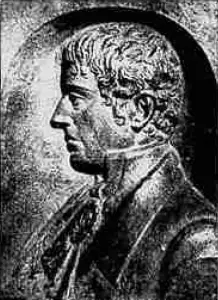
Pietro Conti
Then came Pietro Conti in 1823 with his “tachitipo,” an early shorthand machine designed for rapid transcription. While different in purpose, it pushed the same idea forward: speed, efficiency, and breaking the limits of the pen. The real breakthrough in design came from Giuseppe Ravizza, a lawyer from Novara, who in the mid-19th century built the “cembalo scrivano.” The name— “writing harpsichord”—says it all. It looked and functioned like a small piano, each key producing a printed letter. Ravizza worked on his machine for decades, refining over sixteen prototypes. Even though he never got rich from it, his vision shaped the DNA of typewriters to come.
Now, here’s the twist: all of these Italian efforts predated the commercial explosion of the Remington in 1874. In a sense, Italy was the indie scene, producing brilliant prototypes and cultural buzz, while America became the Hollywood blockbuster, scaling the product for mass markets.
Sicily birthplace of the typewriter. Sicily’s broader legacy of inventions
If the typewriter legend were the only tale, Sicily’s inventive reputation would already be fascinating. But the island has produced (or inspired) a whole gallery of groundbreaking ideas across centuries. Start with Archimedes, the genius of Syracuse in the 3rd century BCE. He designed war machines that baffled enemies: the famous “claw of Archimedes” supposedly lifted and capsized Roman ships, while his burning mirrors allegedly set fleets on fire. Historians debate the details, but the core is clear—Sicily was once home to one of the greatest engineers of antiquity.
Jump to the Renaissance and you meet Francesco Maurolico of Messina. A mathematician and astronomer, he made early contributions to number theory, optics, and geometry. He translated ancient texts and pushed forward the study of light and lenses—centuries before photography or telescopes went mainstream. In the 20th century, Sicily gave us Ettore Majorana, one of the brightest minds in physics. His theories about neutrinos and quantum mechanics remain at the edge of science today. His mysterious disappearance in 1938 only amplified his myth, turning him into Sicily’s own “Einstein-meets-Houdini” figure.
And then there’s food. Let’s not underestimate the cultural power of culinary invention. Sicily is widely credited with shaping the modern concept of gelato, blending Arab sherbet traditions with local snow from Mount Etna and sugar. Cannoli, cassata, pasta alla Norma—these aren’t just recipes, they’re global ambassadors of Sicilian ingenuity. When people bite into a cannolo in New York’s Little Italy, they’re tasting a centuries-old invention born from this island’s creativity. Even industrially, Sicily played a role. In the 19th century, its sulfur mines fueled Europe’s industry, making the island central to the chemical revolution. The extraction techniques may not have been glamorous, but they were innovations that connected Sicily to global progress.
Sicily birthplace of the typewriter. Myth and invention: two sides of the same coin
Here’s the thing about Sicily: it doesn’t separate myth from invention the way other places do. For Sicilians, the boundary between the two is thin, and that’s precisely what gives their creativity its power. Bagolini’s typewriter may not exist in a museum, but the story inspires as if it did. Archimedes’ burning mirrors may never have set ships ablaze, but the tale fired up generations of engineers. Majorana may or may not have vanished to protect dangerous knowledge, but the myth continues to shape how people talk about genius and secrecy.
And myths serve a function. They make innovation memorable. They transform abstract experiments into cultural identity. They say: “Look, we’ve always been ahead of the curve.” In a world that often dismissed Sicily as peripheral or backward, these stories carved out pride and belonging. That’s why the legend of Bagolini matters even if no machine survives. It’s a metaphor for how Sicily sees itself: daring, inventive, sometimes uncredited, but never irrelevant. To put it in American slang: legends are the hype, and hype is half the game. Sicily understood that long before Silicon Valley.
Final thoughts: Sicily’s timeless spark of innovation
Looking back at Sicily’s role in the history of invention, one lesson stands out: innovation doesn’t belong to a single place, time, or culture. It can emerge in the heart of an empire or in a priest’s workshop at the edge of Europe. The legend of Paolo Bagolini, whether fact or myth, captures the essence of an island that has always thrived on curiosity and imagination. Even when history didn’t grant Sicily the patents or the factories, it gave it something equally powerful: the courage to dream first. What makes Sicily remarkable is not only the inventions themselves—whether Archimedes’ machines, Fantoni’s keyboard for his sister, or the culinary miracles of gelato and cannoli—but the way these stories blur boundaries between fact and folklore.
