
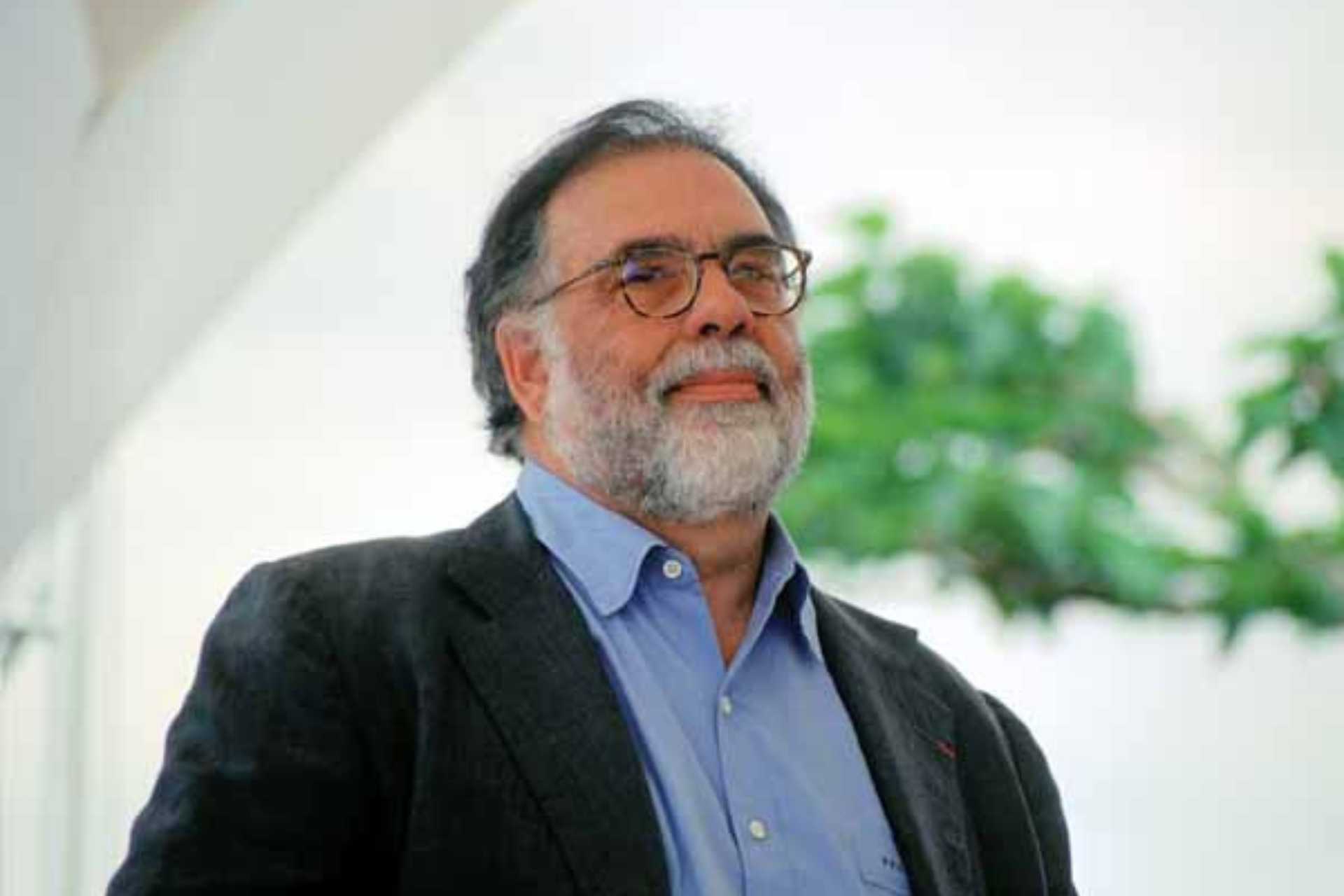
Few filmmakers have reshaped American cinema the way Francis Ford Coppola has. Born in Detroit in 1939 to an Italian-American family, Coppola became one of the central architects of what critics later called New Hollywood. His name is permanently tied to films like: “The Godfather”, “The Conversation”, and “Apocalypse Now”, works that did not just win awards but changed the grammar of modern filmmaking. This is the story of Francis Ford Coppola, from his Italian roots to Oscar triumphs, from artistic breakdowns to cinematic rebirths.
From Detroit to New York: Italian roots and early influences
Francis Ford Coppola was born on April 7, 1939, in Detroit, Michigan, to Carmine Coppola and Italia Pennino. His father, a composer and flutist, was the son of Italian immigrants from Bernalda and Tricarico in Basilicata. His mother was born in New York to Neapolitan parents. The Italian heritage was not just a background detail; it shaped the emotional and cultural atmosphere of his upbringing. Coppola’s middle name “Ford” came from Henry Ford, both because he was born at Henry Ford Hospital and because his father worked in a radio concert series sponsored by the Ford Motor Company. That blend of industry and art would later define Coppola’s career: creative ambition supported by bold, sometimes risky, entrepreneurial moves.
As a child, Coppola contracted polio and spent long periods at home. During that time, he began experimenting with puppetry and amateur filmmaking using his father’s 8mm camera. That early confinement turned into creative expansion. He later studied theater at Hofstra University and film at UCLA, where he refined his technical and narrative skills. Looking back, Coppola once described his early filmmaking drive with striking simplicity: “I was always interested in technology and storytelling.” That combination became the foundation of his cinematic language.
Breaking in: low-budget films and the road to recognition
Coppola’s early career began in the early 1960s under producer Roger Corman, known for giving young directors their first shot. His debut feature, Tonight for Sure (1962), was followed by Dementia 13 (1963), a low-budget horror film that showed flashes of his atmospheric talent. He didn’t explode onto the scene overnight. Instead, Coppola built his résumé through screenwriting and modest directing jobs. He co-wrote the screenplay for Patton (1970), which earned him his first Academy Award for Best Original Screenplay. That Oscar was not just a trophy; it was a door opener.
But Hollywood still wasn’t fully sold. Coppola was young, ambitious, and sometimes considered too intellectual for mainstream studio comfort. Still, he had that spark. As he would later say, “Anything you build on a large scale or with intense passion invites chaos.” That chaos was coming big time.
The Godfather: a risk that changed cinema forever

When Paramount Pictures hired Coppola to direct “The Godfather” (1972), the decision was not universally applauded. Studio executives were skeptical. They resisted his casting choices, particularly Marlon Brando and a relatively unknown Al Pacino. Coppola stood firm. He believed authenticity mattered. He insisted the film reflect the Italian-American experience in a nuanced way, not as caricature. The result? A cinematic earthquake. “The Godfather” became a cultural phenomenon, breaking box office records and winning three Academy Awards, including “Best Adapted Screenplay” for Coppola and Mario Puzo. The film is frequently ranked among the greatest movies ever made by institutions like the American Film Institute.
Coppola later admitted that making the film was an intense battle with the studio. “It was the most difficult film I ever made” he said in interviews. The tension paid off. The film’s operatic structure, moral ambiguity, and visual sophistication redefined crime storytelling. When “The Godfather Part II” (1974) followed, Coppola went even further, weaving past and present into a parallel narrative structure. The sequel won six Oscars, including “Best Picture and Best Director”. It was the first sequel ever to win Best Picture.
“The Conversation” and the art of paranoia
Between the two Godfather films, Coppola directed “The Conversation” (1974), a psychological thriller centered on surveillance and moral anxiety. Starring Gene Hackman, the film explored themes of privacy and guilt in a pre-Watergate atmosphere. Interestingly, Coppola clarified that the script had been completed long before the Watergate scandal. He emphasized that it wasn’t meant as political commentary but as an exploration of human vulnerability. The film won the “Palme d’Or” at the Cannes Film Festival and earned multiple Oscar nominations. Stylistically restrained, it showed that Coppola could shift gears—from mafia epics to intimate character studies—without losing depth. This flexibility became one of his trademarks. He wasn’t boxed in. He wasn’t playing it safe. He was experimenting, pushing, exploring. In today’s slang? The man was built different.
“Apocalypse Now”: “It Is Vietnam”
If “The Godfather” made Coppola famous, “Apocalypse Now” (1979) made him legendary—and nearly broke him. Inspired by Joseph Conrad’s “Heart of Darkness”, the film transposed the narrative to the Vietnam War. The production in the Philippines was notoriously chaotic. Typhoons destroyed sets. Actor Martin Sheen suffered a heart attack. Marlon Brando arrived overweight and unprepared. The budget spiraled out of control. At the film’s premiere in 1979, Coppola famously declared: “My film is not a movie. My film is not about Vietnam. It is Vietnam.” That statement captured the scale of his ambition. He didn’t want to depict war; he wanted to immerse audiences in its madness.
The film won the “Palme d’O”r at Cannes and later earned eight “Oscar nominations”. Over time, it came to be regarded as one of the greatest war films ever made. The production was documented in “Hearts of Darkness”, revealing Coppola’s emotional and financial struggles. He later admitted he nearly lost everything. Yet the artistic triumph proved that risk, when driven by conviction, can yield lasting impact.
Setbacks, Reinvention, and the return of the Godfather
The 1980s were less kind. Films like “One from the Heart” became major box office failures, forcing Coppola to sell assets from his company, “American Zoetrope”. He directed projects partly to recover financially, including “The Outsiders” (1983) and “Rumble Fish” (1983), both of which showcased emerging young actors. Commercial instability followed. “The Cotton Club” (1984) underperformed despite critical praise. Coppola’s reputation fluctuated. Some critics claimed he had lost his edge but he wasn’t done. Not even close.
In 1990, he returned to the Corleone saga with “The Godfather Part III”. Though often compared unfavorably to its predecessors, the film was commercially successful and earned multiple Oscar nominations. Then came Bram Stoker’s “Dracula” (1992), a stylized gothic triumph starring Gary Oldman and Anthony Hopkins. The film won three Academy Awards and reestablished Coppola as a formidable visual storyteller. He proved something important: artistic careers are not linear. They rise, fall, and rise again. As Coppola once observed, “The things you regret most in life are the risks you didn’t take.” He kept taking them.
Legacy, Italy, and a lifelong commitment to art
Beyond Hollywood, Coppola has maintained a deep connection with Italy, particularly Basilicata, where his grandfather emigrated from Bernalda. He became an honorary citizen of the town and invested in cultural and hospitality projects there, including the restoration of Palazzo Margherita. His family has continued the cinematic tradition. His daughter Sofia Coppola became an acclaimed director, winning an “Academy Award for Best Original Screenplay” for “Lost in Translation”. His nephew Nicolas Cage built his own acting career. The Coppola name became synonymous with American cinema.
In 2011, Coppola received the “Irving G. Thalberg Memorial Award”, honoring his career as a creative producer. In 2024, he received the “Kennedy Center Honors”, recognizing his lifetime contribution to American culture. And in 2024, he released Megalopolis, a long-gestating passion project decades in development—a reminder that even in his eighties, Coppola was still dreaming big. His career is a testament to resilience. He didn’t always win at the box office. He didn’t always please critics. But he consistently pursued vision over comfort.
Final thoughts: the unfinished symphony of Francis Ford Coppola
If there is one defining trait in Francis Ford Coppola’s career, it is refusal to settle, to repeat himself safely, or to let failure dictate the next move. From Detroit to Hollywood royalty, from Oscar triumphs to financial collapse and back again, Coppola’s story is not a straight line. It’s a curve, a spiral, sometimes a full-on detour into creative chaos. And yet, somehow, it always circles back to vision. What makes Coppola enduring is not just the masterpieces: “The Godfather”, “The Conversation”, “Apocalypse Now” but the risk embedded in each of them. He never operated on autopilot. Even when returning to familiar territory, as with “The Godfather Part III”, he aimed to expand the moral and political dimensions of the saga. That hunger to push boundaries never really faded.
In recent years, Coppola has demonstrated that ambition does not retire. With “Megalopolis” (2024), a project decades in development, he once again bet on himself. The film, conceived as an epic meditation on civilization and utopia, signals that Coppola remains invested in large-scale, idea-driven storytelling. It’s not nostalgia it’s forward motion. At a stage in life when many filmmakers coast on legacy, Coppola is still chasing new forms.
Recognition has followed. In 2011, he received the “Irving G. Thalberg Memorial Award” for his contributions as a creative producer. In 2024, he was honored with the “Kennedy Center Honors”, solidifying his place among the giants of American culture. These acknowledgments underscore the lasting weight of his influence across generations. Looking ahead, Coppola’s impact will likely expand beyond his own filmography. Through American Zoetrope, his family’s artistic lineage, and his investments in education and cultural initiatives, he has built ecosystems, not just movies. His legacy includes not only films but filmmakers. Francis Ford Coppola stands as proof that cinema is both art and gamble. Sometimes you win big. Sometimes you crash hard. But if you’re bold enough to keep going, you might just redefine the game.
