

Mark Ruffalo Italian roots.
Mark Ruffalo: Italian roots, quiet power, and the art of staying human in Hollywood
In a film industry built on excess, speed, and relentless self-promotion, Mark Ruffalo stands out by doing the opposite. He lowers his voice. He slows his pace. He lets silence, doubt, and vulnerability stay on screen. Ruffalo is not the kind of actor who demands attention. He earns it, scene by scene, through restraint, emotional intelligence, and a deep sense of humanity that feels increasingly rare.
From his Italian working-class background to his rise as one of the most respected actors of his generation, Ruffalo’s story is not about overnight success. It is about endurance. About staying soft in a hard business. About choosing meaning over noise. And yeah, in a world obsessed with hype, that’s kind of a big deal.
Mark Ruffalo Italian roots: identity, labor, and emotional inheritance
Mark Ruffalo was born in Kenosha, Wisconsin, to a family of modest means. His father, Frank Ruffalo, was a construction painter with deep Italian roots, while his mother, Marie Rose, worked as a stylist and hairdresser. The Ruffalo household was shaped by work ethic, instability, and a strong sense of family loyalty, traits often associated with Italian-American culture in the Midwest. Growing up Italian-American in the United States has historically meant navigating two parallel worlds: the private, emotionally rich space of family life, and the public pressure to assimilate, perform, and succeed.
Ruffalo has spoken openly about financial struggles, learning difficulties (he was diagnosed with dyslexia and ADHD), and the feeling of being an outsider even in his early years. This sense of not fully fitting in would later become one of his greatest strengths as an actor.
Italian heritage, shows up in subtler ways: in his physicality, in his expressive silences, in the way his characters often carry emotional weight without verbalizing it. His performances feel inherited rather than constructed. You can almost sense the generational memory there, the unspoken stuff passed down at the dinner table.
In short, his roots didn’t make him flashy. They made him grounded. And honestly, that grounding shows in everything he does.
The long road to recognition: a career built, not manufactured
Unlike many Hollywood success stories, Mark Ruffalo’s career did not explode early. After moving to Los Angeles in his twenties, he spent years struggling, working odd jobs, and performing in small theater productions. He trained at the Stella Adler Conservatory, where he developed a deep respect for craft over celebrity.
His early film roles in the 1990s were mostly independent projects, often low-budget, often overlooked. The turning point came with “You Can Count on Me” (2000), directed by Kenneth Lonergan. Ruffalo’s performance was quiet, raw, and devastatingly human. Critics noticed. Filmmakers noticed. The industry began to see him not as a star, but as something rarer: a reliable emotional truth-teller.
What followed was a steady rise through character-driven films such as “Eternal Sunshine of the Spotless Mind”, “Zodiac”, “Shutter Island”, and “The Kids Are All Right”. Ruffalo became known for portraying men in emotional transition, figures grappling with guilt, love, ethical dilemmas, or quiet despair. He wasn’t playing heroes in the traditional sense, he was playing people.
Then came the unexpected turn: the Marvel Cinematic Universe. Cast as Bruce Banner/Hulk, Ruffalo entered blockbuster territory without losing his artistic credibility. That’s no small feat. While the Hulk is a symbol of rage, Ruffalo’s Banner is fragile, thoughtful, and morally conflicted. He brought restraint to spectacle, which, frankly, saved the character.
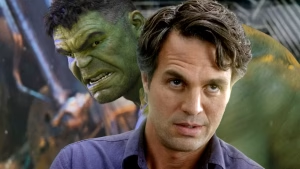
Mark Ruffalo as Bruce Banner/Hulk
Mark Ruffalo Italian roots. activism and values: when fame becomes a tool, not a goal
Mark Ruffalo’s public image cannot be separated from his activism. Over the years, he has become a prominent voice on issues such as environmental protection, clean energy, social justice, and political accountability. But unlike many celebrity activists, Ruffalo’s engagement does not feel performative. His advocacy often comes with discomfort. He is willing to be criticized, misunderstood, or labeled “difficult.” He doesn’t soften his positions to stay likable. And in Hollywood, that’s risky. But Ruffalo seems remarkably uninterested in playing safe. This attitude aligns closely with his Italian-American upbringing, where values are often lived rather than advertised. For Ruffalo, activism is not branding. It’s responsibility. Fame gives him a microphone, and he uses it, even when it costs him roles or popularity points.
That choice reinforces his credibility. Audiences sense when someone means what they say. And Ruffalo does. Whether discussing climate change or democratic rights, he speaks as a citizen first, actor second. In a culture obsessed with neutrality and vague statements, his clarity stands out. Some love it. Some don’t. He’s fine with that. As Americans would say, “He’s not here to play.”
Mark Ruffalo Italian roots. Family life: love, stability, and choosing privacy
Despite decades in the spotlight, Mark Ruffalo has managed to protect something many celebrities lose early: a stable private life. He has been married to Sunrise Coigney since 2000, and together they have three children. Their relationship predates Ruffalo’s fame, and that timing matters.
Ruffalo often credits his wife and family as anchors that kept him grounded during periods of professional uncertainty and personal health challenges, including his battle with a benign brain tumor in the early 2000s. That experience, which temporarily affected his hearing and facial nerves, deeply reshaped his outlook on life and work.
Family, for Ruffalo, is not a public narrative. He doesn’t turn it into content. He doesn’t overshare. Instead, he speaks about it with respect and boundaries. In an era where visibility is currency, his discretion feels almost radical. This commitment to privacy reinforces his public authenticity. What you see on screen is intense, vulnerable, sometimes broken. What you don’t see is his family life, and that separation is intentional. It allows him to give everything to his roles without sacrificing the people who matter most. In plain American slang: he knows what’s sacred, and he doesn’t mess with it.
Mark Ruffalo Italian roots. Acting style: why less has always been more
Mark Ruffalo’s acting style is often described as “natural,” but that word barely scratches the surface. What makes him distinctive is not realism alone, but emotional availability. He allows uncertainty to exist within a scene. He doesn’t rush to resolve tension. He trusts the audience.
This approach places him closer to European acting traditions than to classic Hollywood bravado. His characters hesitate. They contradict themselves. They fail quietly. Ruffalo doesn’t dominate scenes; he listens inside them. That quality makes him particularly effective in ensemble casts. He elevates others by creating space. Directors repeatedly return to him not because he steals focus, but because he stabilizes the emotional center of a film. His Italian heritage subtly informs this style. There is a physical openness, a readiness to feel first and speak later. The body reacts before the intellect. That’s not accidental. It’s cultural, learned, inherited. In a business that often rewards exaggeration, Ruffalo’s restraint is a quiet rebellion. And yeah, it still hits hard.
What’s next for Mark Ruffalo: aging, choice, and creative freedom
As he moves further into his fifties, Mark Ruffalo occupies a rare position in Hollywood. He no longer needs to prove himself, chase relevance, or accept roles for visibility alone. He has creative freedom, financial security, and something even more valuable: trust. The future of his career is likely to include fewer projects, but more intentional ones. He has shown interest in producing, in socially conscious storytelling, and in roles that reflect aging, responsibility, and moral complexity. Ruffalo is not interested in staying young on screen. He’s interested in staying honest. This phase of his career aligns with broader shifts in the industry, where audiences increasingly value authenticity over spectacle. Stories about flawed adults, ethical dilemmas, and emotional accountability are finding space again. Ruffalo is perfectly positioned for that moment. Whether he continues in major franchises, returns to theater, or focuses on behind-the-scenes work, one thing is certain: he will not chase trends. He never has.
As they say in the U.S., “He’s doing his own thing.” And it’s working.
Legacy: why Mark Ruffalo matters more than ever
Mark Ruffalo’s significance goes beyond awards, box office numbers, or critical acclaim. His legacy lies in how he redefined masculinity on screen, offering a model based on empathy, doubt, and emotional responsibility. He made vulnerability visible without turning it into weakness. His Italian-American background gave him depth, not decoration. His career taught patience, not entitlement. His family gave him perspective. His activism gave him voice. Together, these elements form a coherent, rare public figure: one who evolves without erasing himself. In an era that rewards noise, Ruffalo chose resonance. In an industry that pushes reinvention, he chose continuity. And somehow, by staying true to who he is, he became exactly what audiences didn’t know they needed. No gimmicks. No hype. Just a man doing meaningful work, over time.
And honestly? That’s pretty damn impressive.
Final thoughts: quiet strength in a loud industry
When we think about longevity in Hollywood, we often think of reinvention, constant visibility, or the ability to dominate cultural conversation. Mark Ruffalo represents a different model entirely. His career suggests that staying relevant does not always mean staying loud. Sometimes it means staying coherent. Ruffalo’s path shows that consistency of values can be more powerful than constant transformation. He did not abandon his origins to fit into the industry, nor did he turn them into a brand. His Italian-American background, his early struggles, his commitment to family, and his political positions are not marketing tools. They are structural elements of who he is. That coherence is rare, and audiences feel it, even when they cannot articulate why a performance feels trustworthy.
What makes Ruffalo particularly compelling today is his resistance to simplification. He does not offer easy answers, clean heroes, or polished optimism. His characters often sit in moral gray areas, reflecting a world that is increasingly complex and uneasy. In that sense, his work feels aligned with the present moment. Life is messy. People are contradictory. Ruffalo never pretends otherwise. There is also something quietly reassuring about his refusal to chase youth or algorithmic relevance. He allows aging to be visible, doubt to exist, and pauses to remain pauses. In an attention economy that rewards urgency, this slowness feels almost radical. It reminds us that depth takes time, and that credibility cannot be rushed. From an industry perspective, Ruffalo proves that artistic integrity and mainstream success are not mutually exclusive. From a human perspective, he offers a model of masculinity that values care, responsibility, and emotional literacy. And from a cultural one, he shows that heritage and identity do not need to be shouted to be meaningful.
