

Beyoncé European roots.
Beyoncé European roots: from French Creole heritage to global stages
When we speak of Beyoncé, we’re not just talking about music—we’re speaking of movement, metamorphosis, and meaning. Her name alone evokes an entire constellation of associations: power, perfection, poise. Yet behind the global stage lights and viral choreography lies something more intimate—a layered identity shaped by migration, memory, and multiculturalism. Born in Houston but molded by the rhythms of continents, Beyoncé is at once a local girl and a global legend. Her fame may have exploded in the United States, but her lineage traces a path back to Europe—particularly to France—and stretches across the Atlantic into Africa, Canada, and the Caribbean. In an era where authenticity is the currency of influence, Beyoncé’s ability to root herself in history while reshaping the cultural landscape is not only rare, it’s revolutionary.
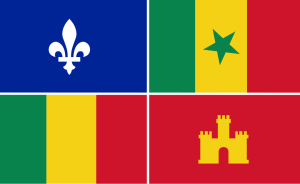
Lousiana Creole Flag
Born in Texas, raised by France: Creole bloodline of Beyoncé
To understand Beyoncé’s essence, we must begin not with her discography, but with her name—a name that carries the imprint of a forgotten empire. Beyoncé Giselle Knowles is not just melodious; it is mnemonic. “Giselle” instantly suggests French grace, ballet, and literary romanticism, while “Beyoncé,” a creative spelling of her mother’s maiden name Beyincé, is a living tribute to matrilineal strength. Her mother, Tina Knowles, descends from the Louisiana Creole community, a group born from the convergence of French colonial settlers, African slaves, Spanish administrators, and Indigenous peoples. The cultural alchemy of the Creole identity is inscribed in Beyoncé’s very being—from her culinary tastes to her fashion sense, from the cadence of her speech to the narratives she chooses to tell. Through her, the deep currents of French colonial history surface in the contemporary realm of pop culture, giving voice to a legacy often obscured in mainstream storytelling. In her visual aesthetics, one can sometimes sense echoes of French Rococo mixed with Southern Gothic—an aesthetic bridge between Versailles and the Bayou.

Beyoncé – Tottenham Hotspur Stadium – 1st June 2023
Beyoncé European roots. Destiny’s Child: girl power with a global accent
Before she became a solo sovereign, Beyoncé reigned in a court of Queens known as Destiny’s Child. Formed in Houston in the early 1990s and managed by her father Mathew Knowles, the group became a cultural powerhouse. With lyrics that centered resilience, dignity, and independence, Destiny’s Child quickly transcended the charts to become a global sisterhood anthem. But Beyoncé wasn’t just a vocalist; she was a strategist, orchestrating the group’s image, choreography, and sound with a precision that reflected her upbringing steeped in discipline and design. Her fashion-forward instincts—often guided by her mother’s Creole-influenced aesthetic—helped position the group as icons, not just musicians. There was something distinctly transatlantic about the Destiny’s Child look: bold yet baroque, urban yet refined. Beyoncé’s creative DNA—fueled by French lineage and Southern fire—was already guiding her to turn every verse into a manifesto and every costume into a coded message. Even in the seemingly light-hearted tracks like Bootylicious, there was a philosophical underpinning: the right to take up space, in body, in voice, in the world.

Destiny’s Child at the Super Bowl XLVII halftime show in 2013 – By Pete Sekesan.
Beyoncé European roots. Reinventing pop: a solo career woven with heritage
Beyoncé’s solo career didn’t merely begin—it erupted. With the release of Dangerously in Love in 2003, she stepped into her own orbit, one shaped less by market trends and more by personal vision. Tracks like Crazy in Love were not just hits; they were sonic declarations of independence. Yet what followed was far more significant. Albums like B’Day, I Am… Sasha Fierce, 4, Beyoncé, and the politically resonant Lemonade mapped out a journey that intertwined personal growth with cultural excavation. Lemonade in particular was a cinematic reckoning with ancestral pain, conjugal betrayal, and Black womanhood. But underneath its American frame pulsed the bloodlines of Europe and Africa—visible in its references to Yoruba deities and Southern Creole rituals, yes, but also in its quiet invocations of French Gothic aesthetics and oral storytelling traditions inherited from the Old World. Even her surprise 2013 release of Beyoncé—a groundbreaking move that broke all traditional promotional rules—felt like an echo of the European avant-garde: unexpected, disruptive, and fiercely modern.
A love story between empires: Beyoncé and Jay-Z
The love story of Beyoncé and Jay-Z is not just a tabloid headline—it’s a study in modern power dynamics, vulnerability, and cultural capital. Their relationship, chronicled through music and media, unfolds like a 21st-century epic. Jay-Z, the streetwise poet from Brooklyn, and Beyoncé, the regal force from the South with European elegance, forged a partnership that is both intimate and imperial. Through albums like Lemonade and 4:44, they navigated betrayal and renewal in full view of the world, reclaiming their narrative through art. But beyond their emotional transparency lies an even greater feat: empire-building. Parkwood Entertainment, Roc Nation, Tidal, Ivy Park—these are not just business ventures; they are monuments to Black entrepreneurship with a distinctly international flair. Beyoncé’s projects often reflect her deep knowledge of French fashion, art, and cinema—whether she’s donning couture on the red carpet or channeling Jeanne d’Arc in her visuals. Their legacy, like old European aristocracies, is built not just on wealth but on influence, narrative control, and cultural endowment.

Shawn Corey Carter (Jay Z) in 2011 by Joella Marano
Beyoncé European roots. The Beychella Effect: culture, not Just concerts
In 2018, Beyoncé didn’t perform at Coachella—she redefined what it meant to headline a festival. Her performance, lovingly dubbed Beychella, wasn’t just a show; it was a ritual, a manifesto, and a syllabus all in one. She became the first Black woman to headline the festival, and instead of opting for universal appeal, she turned the stage into a shrine to Historically Black Colleges and Universities (HBCUs), complete with drumlines, step routines, and Black literary quotations. Yet within this unapologetically African American tribute lay the subtle presence of her Creole background. The flourishes of baroque ornamentation, the operatic pacing of the performance, the semiotic layers—it was all rooted in a transatlantic vocabulary that included not only African heritage but French theatricality and Caribbean syncretism. Her Netflix documentary Homecoming immortalized this moment, transforming it into a global cultural text. Beyoncé’s Coachella wasn’t just a concert—it was a living archive of diaspora identity, proving that you can be simultaneously niche and universal, Southern and cosmopolitan, grassroots and haute couture.
A European soul in a global body: Beyoncé in 2025
Now, in 2025, Beyoncé is more than an artist—she’s an oracle. At 43, she’s curating her own myth, one rooted in history but unbound by convention. Her album Renaissance reintroduced the world to the power of house music, queer ballroom culture, and the underground club scenes that once flourished in the shadows of European metropolises. In doing so, Beyoncé paid homage to communities often erased from history while wrapping their legacies in global celebration. At the same time, she remains devoted to her Creole-European heritage, speaking French in philanthropic campaigns, and preserving the essence of her ancestors in the meticulous care she brings to every visual and sonic detail. Her children—Blue Ivy, Rumi, and Sir—are being raised not only in opulence but in awareness. In interviews and performances, Beyoncé continues to weave French phrasing, Creole spirituality, and African storytelling into her narrative tapestry. She is not marketing diversity; she is embodying it.
Conclusion: why Beyoncé belongs to the world (but carries Europe in her blood)
To say Beyoncé is an American icon is correct, but insufficient. She is a child of the diaspora, a product of multiple worlds, a performer whose very name is a cipher for French-Creole resistance and renewal. Her life’s work, both subtle and seismic, is a masterclass in how to carry heritage forward without being confined by it. She builds bridges—between Houston and Paris, between 18th-century French Louisiana and 21st-century digital activism, between ancestral memory and future possibility. If France celebrates Bastille Day on July 14 and Canada honors Saint-Jean-Baptiste on June 24, perhaps it’s time we recognize September 4 (Beyoncé’s birthday) as something more than a birthday. It’s a symbolic day for global identity. For feminine resilience. For art that dares to remember. Beyoncé is not a footnote in history. She is a chapter—and it’s written in many tongues.
