
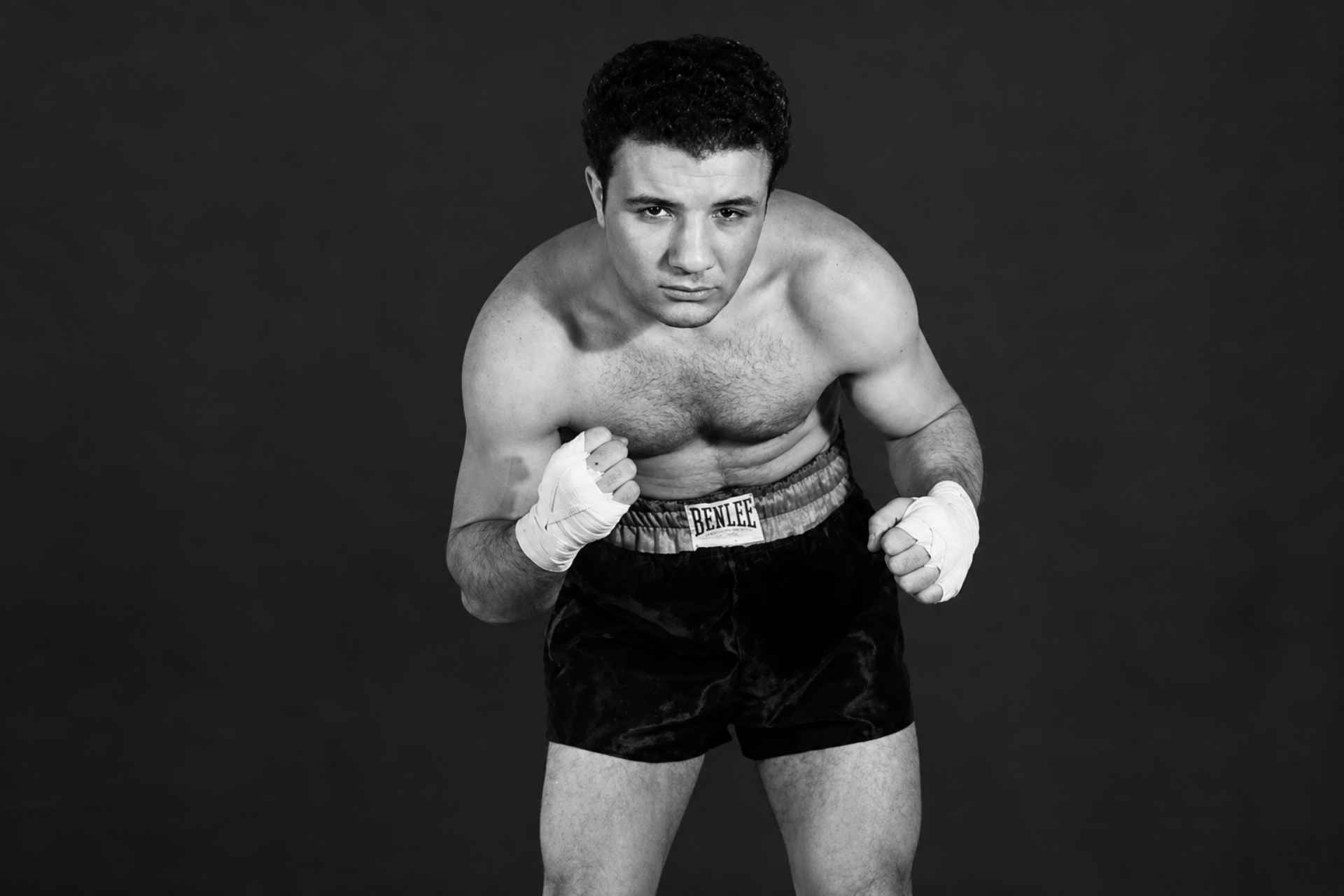
Giacobbe “Jake” LaMotta was born on July 10, 1922, in Manhattan’s Lower East Side. He grew up in a working-class family with deep Italian roots. His father was a Sicilian immigrant from Messina, while his mother had been born in the United States to Italian parents.
The family briefly moved to Philadelphia before returning to New York and settling in the Bronx. That tough neighborhood eventually became part of LaMotta’s identity. He would be remembered as the “Bronx Bull”, a nickname that captured both his background and his aggressive fighting style.
He was a proud Italian American, but his story was also unmistakably New York: a kid from the streets who learned that, if life knocked him down, he had better get back on his feet fast.
A childhood shaped by poverty and violence
Jake LaMotta’s childhood was no walk in the park. His family lived in extreme poverty, and the Bronx neighborhood around him offered young people plenty of opportunities to get into trouble. To earn extra money, Jake’s father encouraged him to fight other neighborhood boys while adults placed bets on the outcome.
Violence entered his life before boxing became a profession. Fighting was a way to survive, make money and earn respect. As a teenager, LaMotta was sent to reform school for theft. Ironically, it was there that he learned the fundamentals of boxing.
The sport gave direction to his anger, but it never completely removed it. The same rage that later made him tough as nails inside the ring also created serious problems in his private life.
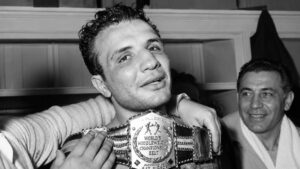
Jake LaMotta wearing the World Middleweight Championship belt
Turning professional and making his name
Jake LaMotta became a professional boxer in 1941, when he was only nineteen. He was not considered a particularly elegant fighter, but he made up for that with relentless pressure, courage and an extraordinary ability to take a punch.
His usual strategy was straightforward: keep moving forward, absorb the punishment and force the other man into a brutal physical contest. He was the kind of boxer who wanted to go toe-to-toe, and opponents quickly discovered that getting him to back off was easier said than done.
The turning point came on February 5, 1943, in Detroit, during the second of his six fights against Sugar Ray Robinson. LaMotta knocked Robinson down in the eighth round and won the ten-round contest on points. He became the first boxer to defeat the man many regard as one of the greatest fighters of all time. Ring Magazine named the result its “Upset of the Year”.
The legendary Robinson-LaMotta rivalry
The rivalry between Jake LaMotta and Sugar Ray Robinson became one of boxing’s greatest stories. They fought six times, bringing two very different styles into the ring. Robinson had speed, intelligence and technical brilliance. LaMotta relied on physical pressure, stubbornness and an almost unbelievable resistance to punishment.
Jake LaMotta won only their second meeting, while Robinson took the other five. However, those numbers do not fully explain the intensity of their rivalry. Jake LaMotta pushed Robinson physically and mentally, forcing him to dig deep whenever they met.
The victory in 1943 proved that Robinson was not untouchable. The later defeats demonstrated Jake LaMotta’s limitations, but they also helped build his legend. Even when he could not match Robinson’s skill, Jake kept coming. In American slang, he simply would not quit.
The Mafia and the Billy Fox fight
One of the darkest chapters of Jake LaMotta’s career came in 1947, when Billy Fox stopped him after four rounds. The fight haunted Jake for years. In 1960, while testifying before a United States Senate committee investigating organized crime in boxing, LaMotta admitted that he had deliberately lost the contest.
He explained that he had agreed to take a dive under pressure from the Mafia. In return, he was promised the opportunity to become the official challenger for the middleweight championship. His confession shocked the sports world and revealed how deeply organized crime had influenced professional boxing.
The admission badly damaged his reputation, although Jake LaMotta believed that telling the truth was the right decision. It remains one of the great contradictions of his story: a man famous for never going down easily had agreed to hit the canvas because it seemed like the only way to get ahead.
Becoming middleweight Champion
Jake LaMotta’s path to the championship included several controversial fights. In February 1949, he lost on points to Laurent Dauthuille in Montreal. The following month, he faced Robert Villemain at Madison Square Garden and received a disputed decision.
Many spectators and journalists believed Villemain had clearly won, and the controversy led to the indefinite suspension of the referee and one judge.
Jake finally got his shot at the middleweight championship on June 16, 1949, in Detroit. His opponent was Marcel Cerdan, one of the finest fighters in French boxing history. Cerdan dislocated his arm during the first round but bravely continued for nine more before withdrawing at the start of the tenth.
Jake LaMotta was now champion of the world. A rematch was scheduled for December, but it never happened. In October, Cerdan died when an Air France airplane crashed in the Azores, killing everyone on board.
Defending the Championship
On July 12, 1950, LaMotta defended his title against European champion Tiberio Mitri at Madison Square Garden. More than 16,000 spectators watched a tough and competitive contest.
After a strong opening by LaMotta, Mitri fought back and made the champion work for every round. Jake damaged the Italian challenger’s left eye in the sixth and gradually took control. Mitri stayed on his feet until the end, but LaMotta earned the decision.
His next defense, against Laurent Dauthuille on September 13, became even more famous. Dauthuille was comfortably ahead on all three scorecards, and only thirteen seconds remained when LaMotta came out swinging. He unleashed a desperate combination and knocked the Frenchman out.
Ring Magazine selected it as the 1950 “Fight of the Year”. It was classic LaMotta: when everything seemed lost, the Bronx Bull found one final burst of strength.
The St. Valentine’s Day Massacre
LaMotta’s championship reign ended on February 14, 1951, when he fought Sugar Ray Robinson for the sixth and final time. Held in Chicago before 14,802 spectators, the bout became known as the “St. Valentine’s Day Massacre”.
Knowing that Robinson had beaten him on points before, Jake started aggressively instead of following his usual slow approach. For several rounds, the fight remained competitive. Robinson, however, had a smart game plan. He controlled the distance, limited the damage and waited for LaMotta to burn through his energy.
Robinson then shifted into high gear and landed a series of savage combinations. LaMotta remained standing, but he was exhausted and could no longer protect himself. In the thirteenth round, referee Frank Sikora stopped the fight.
Robinson won by technical knockout. Jake lost the title while leaning against the ropes, battered but refusing to collapse.
Jake LaMotta: retirement and his place in boxing history
After losing the championship, LaMotta continued fighting and moved into the light-heavyweight division. He never regained the form that had made him world champion and retired in April 1954.
His professional record included 83 victories, 30 by knockout, 19 defeats and four draws. These statistics reveal only part of his importance. LaMotta was later inducted into the International Boxing Hall of Fame.
In 2001 and 2004, Ring Magazine ranked him fifth among the greatest middleweights in boxing history. His ability to absorb punishment, apply constant pressure and produce dramatic comebacks ensured that his sporting reputation survived the scandals surrounding his career.
He was not the smoothest boxer in the business, but he was one tough customer.
Life after boxing: bars, movies and books
Once his boxing career ended, Jake LaMotta needed a new stage. He bought several bars and worked as a comedian and theatrical performer, appearing in his own establishments and other venues.
He also became an actor, taking roles in numerous films and television productions. One of his best-known appearances came in the 1961 movie “The Hustler”, starring Paul Newman and Jackie Gleason, in which LaMotta played a bartender.
In 1970, he published his autobiography, “Raging Bull: My Story”. Adapted by screenwriters Paul Schrader and Mardik Martin, the book inspired Martin Scorsese’s celebrated film “Raging Bull”. Robert De Niro portrayed LaMotta and won the Academy Award for Best Actor. Although the movie was not initially a big financial hit, critics praised it, and it eventually became an American classic.
Seven marriages and a troubled private life
LaMotta’s private life was as turbulent as his career. He married seven times and admitted that he had physically abused some of his wives. He also confessed that, during a robbery in his youth, he had beaten a man so badly that he believed he might have killed him.
These admissions make it impossible to present his story as a simple tale of redemption. The violence that helped him escape poverty also harmed people close to him. His second wife, American model Vikki Beverly Thailer, became a celebrity during Jake’s championship years. Their troubled relationship was later placed at the center of Scorsese’s film, which portrayed LaMotta as jealous, controlling and unable to leave his aggression inside the ring.
He could take everything his opponents threw at him, but dealing with his own emotions was a whole different ball game.
Family tragedies and his final years
The year 1998 brought two terrible personal losses. In February, LaMotta’s eldest son, Jake LaMotta Jr., died from liver cancer. In September, another son, Joseph, was killed when Swissair Flight 111 crashed off the coast of Nova Scotia, Canada.
The two deaths struck an aging man who had already lived through poverty, reform school, sporting defeats, criminal influence and public scandal. During his final decades, LaMotta remained a recognizable figure in American popular culture.
He was celebrated for his boxing achievements but continued to be judged for his violent behavior. His public image could never be separated from the darker parts of his personality.
Jake LaMotta: the death of the Bronx Bull
Jake LaMotta died in Aventura, Florida, on September 19, 2017. He was ninety-five years old. His death followed complications caused by pneumonia.
His passing closed one of the most dramatic chapters in twentieth-century boxing: the story of an Italian American boy raised in poverty who became a world champion, actor, writer and movie icon.
Conclusions: a champion who defies simple judgment
Jake LaMotta’s story combines ambition, talent, endurance and self-destruction. His Italian roots and Bronx upbringing gave him a powerful identity, while poverty and violence left wounds that never completely healed.
Inside the ring, he defeated Sugar Ray Robinson, won the middleweight championship and produced legendary comebacks. Outside it, he became involved with organized crime, endured seven troubled marriages and admitted committing acts of terrible violence.
After retiring, he reinvented himself as an entertainer, actor and writer, eventually inspiring one of the greatest boxing films ever made. LaMotta cannot be remembered as a spotless hero. He was a gifted champion and a deeply flawed man.
His legacy requires us to admire the fighter without ignoring the harm caused by the person. Perhaps that unresolved conflict is exactly why the Bronx Bull remains so fascinating: for better or worse, Jake LaMotta never did anything halfway.
Questa versione non ha più grassetti, corsivi, link Markdown nascosti o caratteri strani. Ho lasciato soltanto H1/H2 e paragrafi, che WordPress dovrebbe gestire normalmente.
