
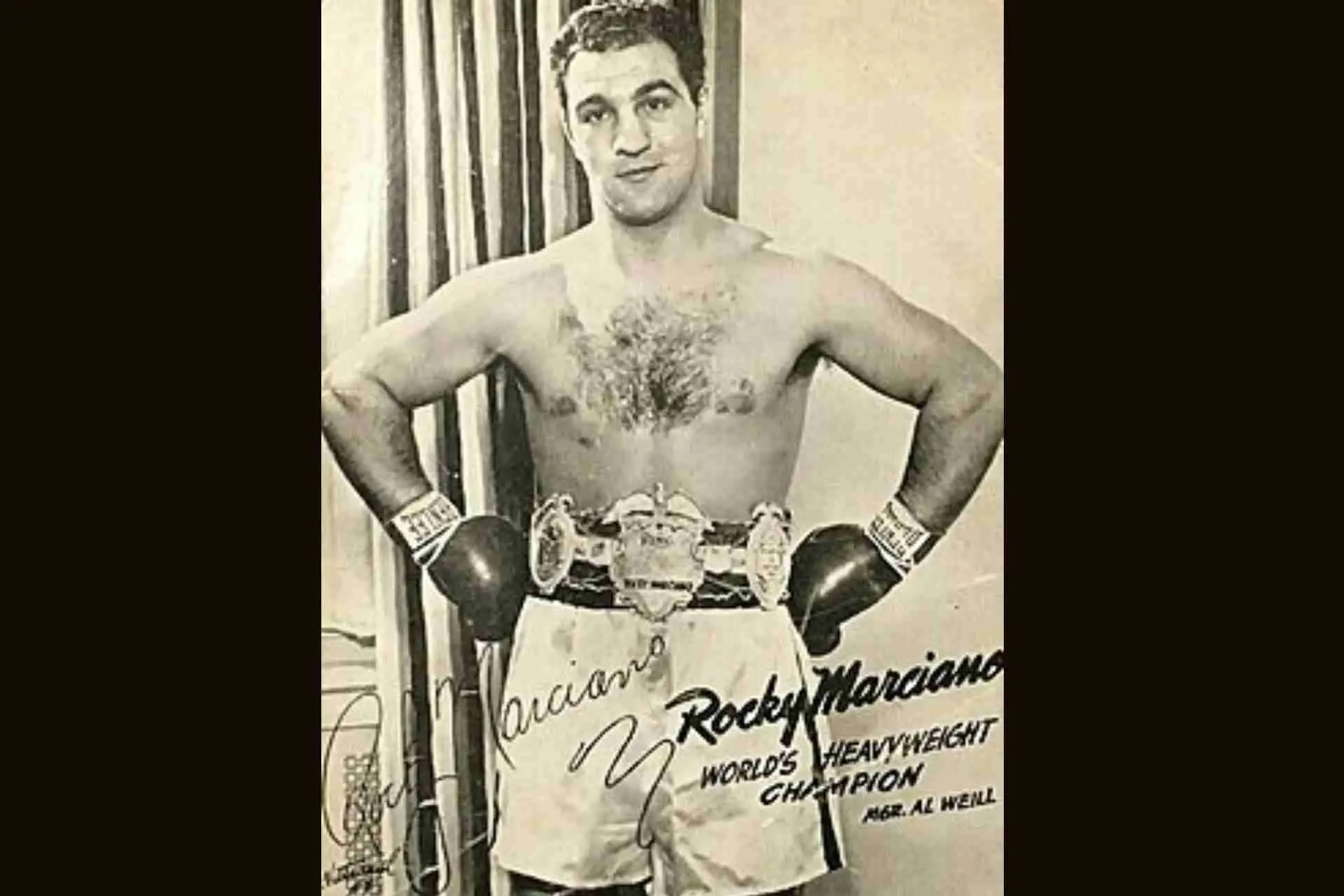
Rocky Marciano Italian-American.
Rocky Marciano Italian-American
Introduction: the weight of heritage
When we look back at the story of boxing in the United States, few names resonate as strongly as Rocky Marciano. He is remembered not only for his perfect record of 49 victories without a single defeat, but also for the way he embodied the immigrant dream. Born Rocco Francis Marchegiano in Brockton, Massachusetts, in 1923, the son of Italian parents from Abruzzo, Marciano grew up in a working-class neighborhood where hardship was the daily bread. His rise to greatness was not inevitable. It was forged through sweat, sacrifice, and the values of a culture he never abandoned. In the ring, he was unstoppable; outside it, he remained a man who carried Italy in his heart and America on his shoulders.
Rocky Marciano Italian-American. The roots in Abruzzo and the life in Brockton
Marciano’s story begins across the Atlantic, in the rugged hills of Abruzzo. His father, Pierino Marchegiano, came from Ripa Teatina, a small town near Chieti, where traditions were strong and life was tied to the land. Like many Italians at the beginning of the twentieth century, Pierino emigrated to America in search of work. He settled in Brockton, Massachusetts, a city built on industry, with shoe factories that demanded long hours and paid little. There he married Pasqualina Picciuto, also of Italian origin, who joined him in building a new life. The household was marked by an unmistakable Italian rhythm. Dialect was spoken at the table, Catholic faith structured the week, and meals were prepared with recipes that came directly from Abruzzo. Marciano grew up hearing the stories of a homeland he never saw as a child but which remained present in the gestures, songs, and foods of his parents. For many Italian-Americans of that generation, the cultural identity was not diluted but reinforced by distance, and for Rocky it became a defining element of his character. Brockton itself was a city of immigrants: Irish, Italians, Portuguese, and others lived side by side, often competing for jobs and status. Italian-Americans were frequently subject to prejudice, seen as outsiders in their own country. Yet it was in this environment that Marciano learned resilience, loyalty to family, and the importance of proving oneself not only for personal pride but for the honor of a community.
Rocky Marciano
Rocky Marciano Italian-American. Youth between hardship and dreams
As a boy, Marciano was not destined for glory. He struggled in school and dropped out before completing his education. He worked a series of jobs to help support his family: carrying ice, digging ditches, and laboring in the shoe factories. Like many children of immigrants, he experienced both the burden of responsibility and the dream of escape. Baseball was his first passion. He hoped to become a professional player and even had a tryout with the Chicago Cubs. A strong arm and natural athleticism seemed to promise a future, but a shoulder injury ended that dream. For a while, it seemed he would remain in the cycle of hard labor that had defined his father’s life. World War II changed everything. Drafted into the U.S. Army, Marciano served overseas and discovered boxing almost by chance. He began fighting in amateur bouts organized for soldiers. What started as recreation quickly revealed a natural strength and determination. After returning to civilian life, he trained seriously, entering the world of professional boxing in 1947.
Rocky Marciano Italian-American. The relentless rise of a champion
Marciano’s style was not graceful, but it was devastating. At just under six feet tall, he was shorter than many heavyweights, yet he compensated with raw power, endurance, and an iron will. His right hand, nicknamed “Suzie Q,” became legendary for its knockout force. He fought not with finesse but with unyielding pressure, wearing down opponents until they collapsed. His rise was rapid. From his first professional fights, he drew attention for his ability to finish matches with explosive power. Fans admired not only his strength but also his refusal to surrender. He could take punishment and keep coming forward, a quality that made him both feared and respected. In 1952, Marciano faced Jersey Joe Walcott for the heavyweight championship. It was a dramatic fight that seemed to slip away from him in the early rounds. Walcott knocked him down and controlled much of the bout, but in the thirteenth round Marciano unleashed his right hand in a blow that instantly ended the contest. Walcott fell, and Marciano became champion. The victory symbolized not just a personal triumph but the culmination of years of sacrifice and resilience. Marciano defended his title six times, defeating respected fighters such as Ezzard Charles, Roland LaStarza, and Archie Moore. Each fight reinforced his reputation as unstoppable. When he retired in 1956, at the age of 32, his record was 49 wins, 43 by knockout, and no defeats. No heavyweight before or since has managed to leave the ring undefeated with a world title.
Rocky Marciano Italian-American. The symbol
Marciano’s victories resonated far beyond the ring. For Italian-Americans, he was a hero. In an era when their community was still often marginalized, his success provided pride and recognition. He showed that the son of immigrants could stand at the very top of American sport, proving his worth in the most public of arenas. In Italy, Marciano was embraced as a native son. When he visited, crowds celebrated him with banners and cheers, as though he had brought glory directly to the nation. He was living proof of how Italian blood and values could flourish in the New World. Abruzzo, the land of his parents, adopted him as a symbol of its resilience. Today, Ripa Teatina hosts events in his honor, celebrating his dual identity. The connection between Marciano and Italian heritage also influenced culture. Sylvester Stallone’s character Rocky Balboa, created in the 1970s, drew inspiration from him. The underdog fighter of Italian descent who refuses to give up owes much to the image of Marciano. Through this, his legacy extended into cinema, shaping American popular culture and reinforcing the Italian-American narrative of determination and triumph.
Rocky Marciano Italian-American. The man behind the gloves
Beyond the legend, Marciano was a man of habits and peculiarities. He was frugal, often carrying food with him rather than spending money in restaurants. Friends recall him traveling with spaghetti wrapped in wax paper, a reminder of his family traditions. His discipline was not only physical but also economic, shaped by the modest means of his upbringing. His training methods were unconventional but effective. He ran long distances, chopped wood, and toughened his fists on homemade bags filled with rocks. These old-fashioned practices forged an endurance that allowed him to fight deep into rounds without losing strength. Despite his fame, Marciano remained humble and closely tied to his family. He visited Italy, met relatives, and maintained strong ties with his community in Brockton. Yet he also felt the pressure of expectations. Being the undefeated champion meant carrying an image of invincibility that was both a blessing and a burden. His life ended tragically in 1969, the day before his forty-sixth birthday, when the small plane he was traveling in crashed in Iowa. The suddenness of his death shocked both America and Italy. It froze his image in time, leaving him forever young, undefeated, and heroic.
Rocky Marciano Italian-American. A legacy without defeat
Today, Rocky Marciano’s name remains synonymous with perseverance. His perfect record stands as a monument to discipline, resilience, and determination. But numbers alone do not explain his importance. Marciano represented the journey of millions of immigrants, particularly Italian-Americans, who sought respect and a place in American society. He was a champion not only for himself but for his community. In a broader sense, Marciano’s life illustrates how sport can bridge cultures. He showed that identities need not be divided. He was both Italian and American, drawing strength from both heritages. His victories belonged to the world, but they carried within them the history of Abruzzo, the struggles of immigrants, and the optimism of the American dream. As time passes, legends often fade, but Marciano endures. His story has been retold in films, books, and celebrations on both sides of the Atlantic. In Brockton, his hometown, a statue commemorates him. In Italy, his memory continues to inspire. For Americans who cherish Italy and its contributions, Marciano remains an emblem of how heritage can shape destiny and how determination can overcome every obstacle.
Conclusion: more than a fighter
Rocky Marciano was more than a boxer. He was the child of immigrants, the hope of a community, and a bridge between two worlds. His fists may have written the statistics, but his life told a deeper story about perseverance, sacrifice, and identity. For American readers with a love of Italy, Marciano embodies the strength of a heritage that did not disappear in the New World but found new expression in it. His undefeated record may never be matched, but his greater triumph was the way he turned the struggles of one family, and by extension an entire generation of Italians, into a narrative of victory. He fought in the ring, but he also fought against prejudice, against poverty, and against the weight of expectations. And in every battle, he never lost.
